Forgetting the ‘Middle Child’: Why Neglecting Your ‘Better’ Assortment is..
Forgetting the ‘Middle Child’: Why Neglecting Your ‘Better’ Assortment is Costing You Profit
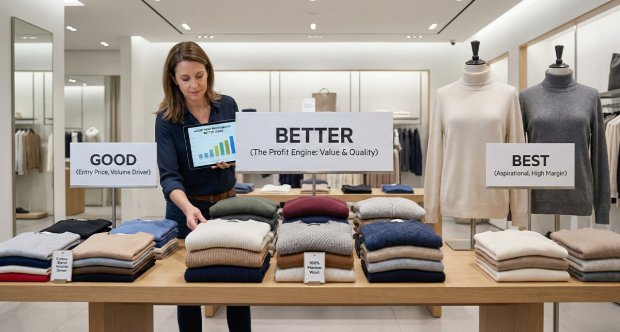
As retail professionals, we often build our ranges using a 'Good, Better, Best' (GBB) framework. It is a classic merchandising strategy, taught and used everywhere.
The good products have the lowest prices and they are good value for money. Their primary role is to attract shoppers into the store to browse the full assortment. The better segment is where the biggest share of sales will be made. The products are a bit more expensive but also of higher quality than the good products. An example is sweaters. In the good segment they may be made with man-made fibres. In the better segment they may be made from wool or cotton. They may also have more choice. The best segment has the highest prices, the biggest gross margin percentages and obviously are higher quality than the better products. Our sweater may be made of wool containing a percentage of cashmere for example. At the top end of best, it may be 100% cashmere. The average purchase value of individual sweaters, for example, will be roughly in the middle of the better price range. A primary objective of having an expensive best product is to make shoppers appreciate the value of the better items more. Doing this successfully will move the average price paid upwards.
Finding the Profit in the 'Middle'
A common mistake I see is a Buying team simply pricing an item higher and calling it 'Better', without adding any demonstrable features, better fabric, or a stronger warranty. Customers are not fooled by this; they just see a poor-value 'Good' product. A strategic approach we train at Martec shifts the discussion from price to value. When your teams get this right, it directly protects your P&L in three critical ways:
1. Preventing Margin Erosion When the step-up in genuine value from 'Good' to 'Better' is not clear, the customer often defaults to the 'Good' price point. In this case, you have not just made a sale; you have lost the incremental cash margin you could have had. The customer was often willing to pay more, but your assortment failed to convince them. You have actively encouraged them to trade down.
2. Reducing Lost Sales There is a large, profitable cohort of customers who want more than your entry-level 'Good' product but cannot justify the price or features of your 'Best' tier. If your 'Better' option is weak, confusing, or poor value, they do not trade down; they simply leave. They go to a competitor who has a compelling mid-tier offer. This is a direct lost sale and a long-term erosion of your market share.
3. Protecting Inventory and 'Open to Buy' When a 'Better' range is ill-defined, it often becomes a dumping ground for products that do not quite fit the other two tiers. This confuses the customer, slows your stock turn, and ties up your valuable 'Open to Buy' in products that will inevitably require a deeper markdown. This is a direct hit to your cashflow and inventory carrying costs.
Conclusion Stop treating your 'Better' assortment as just a stepping stone between 'Good' and 'Best'. For most retailers, this middle tier should be the real engine of profitability, balancing healthy volume with strong cash margin. The key is a structured analysis of value, and that starts with equipping your Buying and Merchandising teams with the commercial skills to build a range that leads the customer up the value chain. Ideally, the customer should be drawn into the store by the "Good" price points, easily see the step up in value for the "Better" and then spend more money there. Brand fans and wealthier customers may buy in "Best" and create greater margin.
If you would like to explore a detailed framework on how to build a profitable 'Good, Better, Best' assortment, you can find it in our Retail and Consumer Goods Industry WIKI.
-
Posted by Martin Dugan
17th December 2025