


E-Commerce and Omni-Channel
E-commerce and Omni-Channel Career Paths
Most online retailers are also multi-channel. The map below shows a potential career path map for the E-Commerce department in an omni-channel retailer. The solid lines connect job roles that are likely to be found in the E-Commerce Department itself. Those with dotted lines are stand alone departments that provide services to the E-Commerce Department. For example, a pure play online retailer will of necessity have its own Buying and Merchandising Department, but most omni-channel retailers will have a company wide Buying & Merchandising Department which buys for stores and online, and sometimes for wholesale too, if they have that channel.
In the early days of E-Commerce retailers often had a dedicated e-commerce warehouse and distribution centre. Nowadays, most have a shared warehouse, or perhaps more than one. That warehouse will potentially have two extra elements that would not be there in most stores only businesses. The first is a unit that takes care of home deliveries of online orders, possibly dispatching by parcel post or third party carriers. The second is a returns processing centre.
The returns processing centre will receive returns direct from customers and from stores when consumers return an unwanted item there. These items will be examined and classified into 4 categories:
1. It can go back into free stock and available for sale immediately
2. It can go back into free stock with some repackaging (for which that unit will be equipped)
3. It needs some repair which will need to be carried out before it can go into free stock
4. It is too damaged and will need to be written off.
Marketing, Store Operations, IT, Finance and HR will also perform their share of support activities for E-Commerce. IT will have people who manage the maintenance of the online web site and the operation of the systems necessary to make everything function smoothly.
If the retailer is an online only retailer, it will need all these functions in addition to those shown with solid lines. In terms of upskilling a workforce, the skill definitions and learning paths needed will be the same for these shared functions as for dedicated departments.
Career Path Map
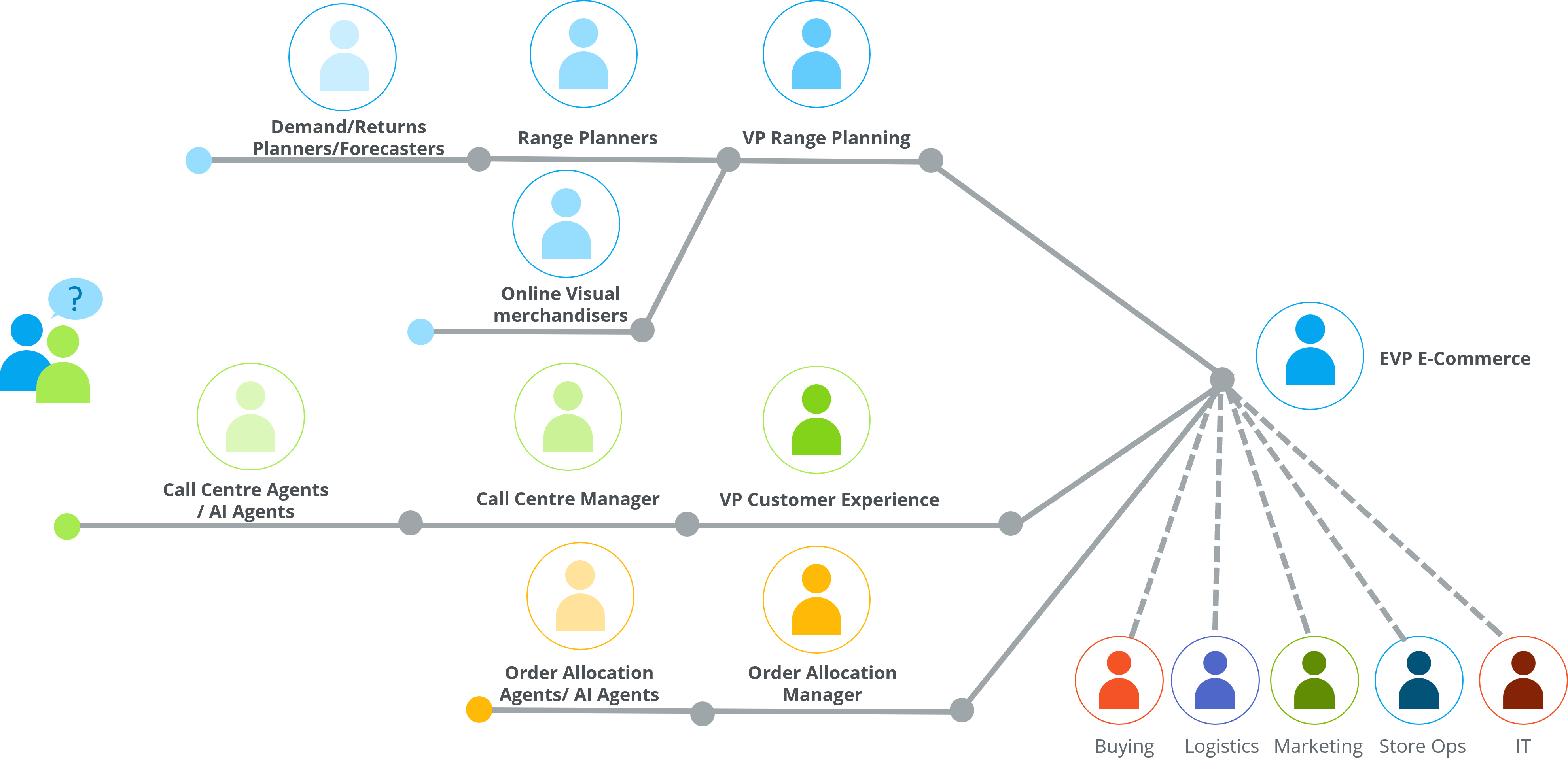
E-Commerce Roles
Call Centres
All e-commerce operations have a call centre to handle enquiries, queries, complaints, etc. from consumers. Currently, these departments are staffed by human agents, but some now have AI chatbot support. These have been built using generative AI systems and mostly can only do limited functions. It is possible that the chatbots will fade away, though this is by no means certain.
AI enthusiasts believe that AI agents will gradually replace human agents, though they are unlikely to replace all human agents. One reason as that AI agents will take some time to build the full set of training to deal with every type of query. Another is that e-commerce department managers cannot be plucked out of the air, they will need to build some experience in handling the difficult queries that AI may never get to. Call centre managers will also need to manage AI agents, when errors or hallucinations are found, which need addressing. This means providing additional training data to stop re-occurrences – a new skill set.
Order Management
E-commerce profitability improves when sophisticated order management processing can allocate order fulfilment in the smartest way possible. This may mean fulfilment from the warehouse or from a nearby store that has stock available. Order management systems provide this capability, but they need oversight and occasional adjusting of the rules. There may be some situations where order management agents intervene in decisions and there may be AI agents to do this in future. Again, they will need managing as errors and problems arise.
Among the problems to be addressed is serial returners. A serial returner is a customer who sends back far too many items and orders multiple sizes of the same thing intending only to keep one. Some of these customers just get too expensive to service and at some point someone puts a block on processing their orders.
Sometimes orders are paid for with a credit card, which subsequently bounces and the issue needs to be resolved before the order can be dispatched.
Range or Assortment Planning
In many cases range or assortment planning may be done by the corporate Buying and Merchandising department, but there may be cases where policy dictates that some must be done in the e-commerce function. An obvious example is when the online business carries a much wider range than the stores. Merchandise planning, assortment planning and open-to-buy management is more complicated in online and omni-channel retailers because of the complexities of managing returns and not buying too much inventory only to have some returned.
Demand Forecasting
Demand forecasting for online retail is also more complicated because of the need to forecast returns. Online returns in some categories are so high, that poor forecast accuracy can mean greater lost sales than is normal with a store chain.
Online Visual Merchandising
Online VM can be carried out by members of a central VM team provided they have been trained in the differences, but it may be more effective to have a direct resource in the E-commerce department.
Martec’s training in merchandise planning, assortment planning, OTB, demand forecasting and space management/visual merchandising incorporates content on the impact of online or omni-channel operations.