


Martec's Upskilling and Reskilling toolkit
For retailers, consumer goods manufacturers, consultants, systems integrators, retail software companies, accounting firms and third-party logistics companies we provide an upskilling and reskilling toolkit based on the methodology described in this paper and a portfolio of training products and supporting services.
We address the industry aspects of the training need and provide related tools.
Overview
Our toolkit is available for purchase to support this methodology including the following elements:
 |
Learning & Guidance |
|
 |
Tools and Templates |
|
 |
Learning Paths Library |
|
A growing library of structured learning paths, including:
The learning path definitions follow the example given in this paper and include the skills making up the required competency for a particular role and a typical job description. |
 |
Learning Experience |
|
Our learning paths combine:
|
You can find the toolkit in the Martec online shop, should you be interested in purchasing it.
Class Portfolio
In terms of the class portfolio, Martec address all the retail and consumer goods elements with our product set. In our case, our consumer goods company product portfolio addresses the relationship between the manufacturer and the retail or wholesale customers. It covers supply, chain management, the sales, and marketing interface to retailers including trade promotion support and category management and finance and collaboration between the parties. It does not cover manufacturing, although there is manufacturing content in the Retail and Consumer Goods Industry Knowledge Bank.
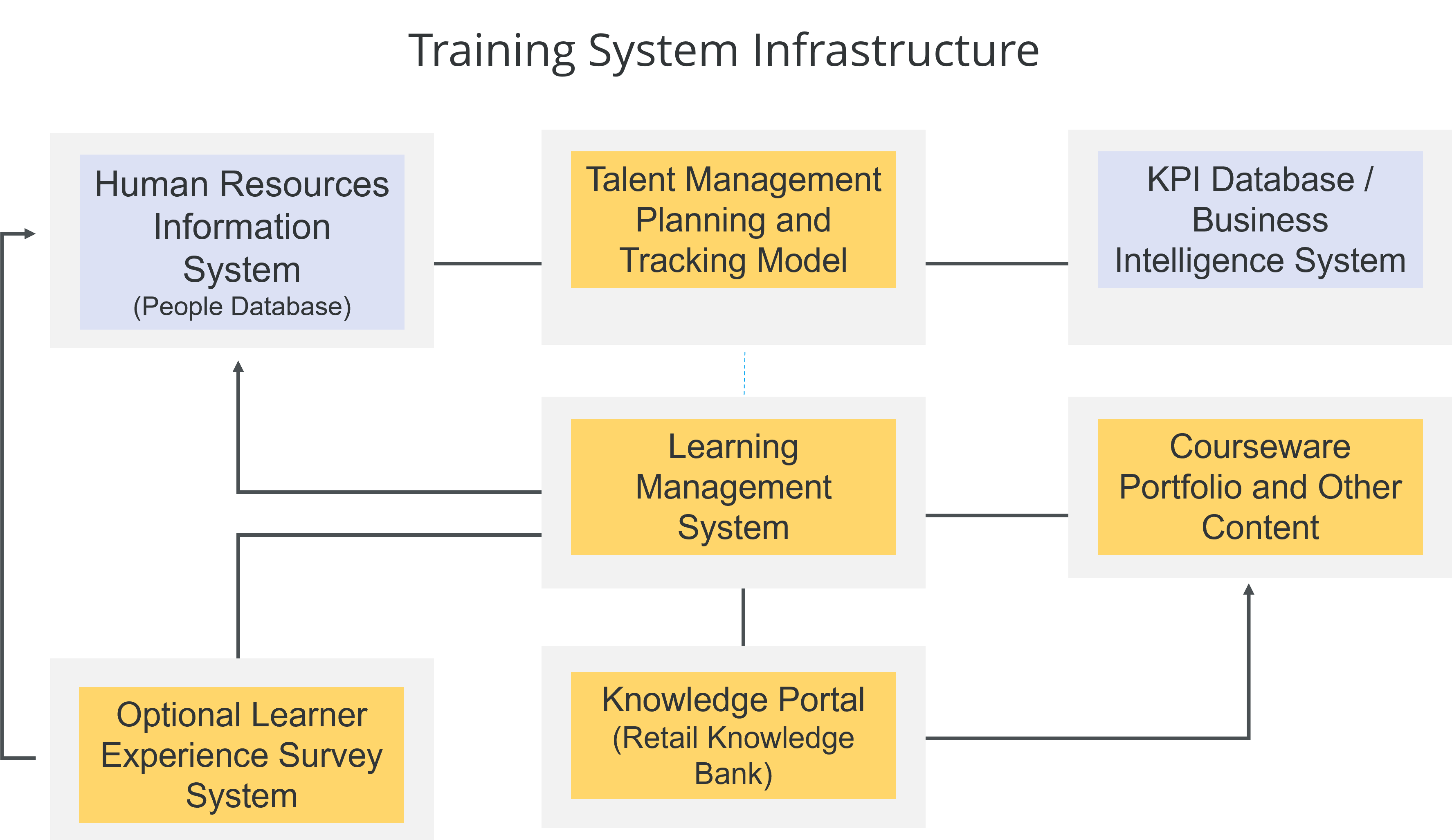
We provide a hosting service for smaller companies without their own learning management system, or those who choose to use us for hosting their pilot project. While clients must source their soft skills training from other companies, we are happy to host it for them, if their supplier agrees.
The chart below illustrates our infrastructure. Captions in blue are covered by Martec, and the other data needs to be supplied by the client.
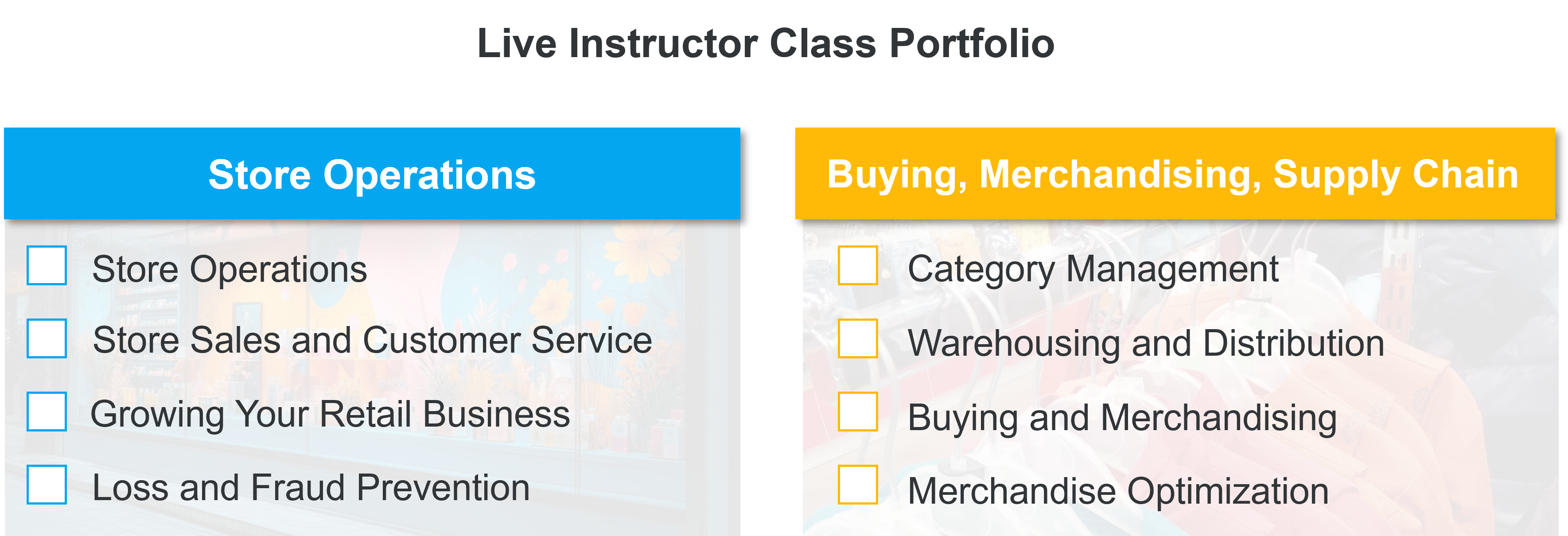
The following two tables list our current class portfolio. We release additional classes periodically and you can find the current status in the Martec Shop.
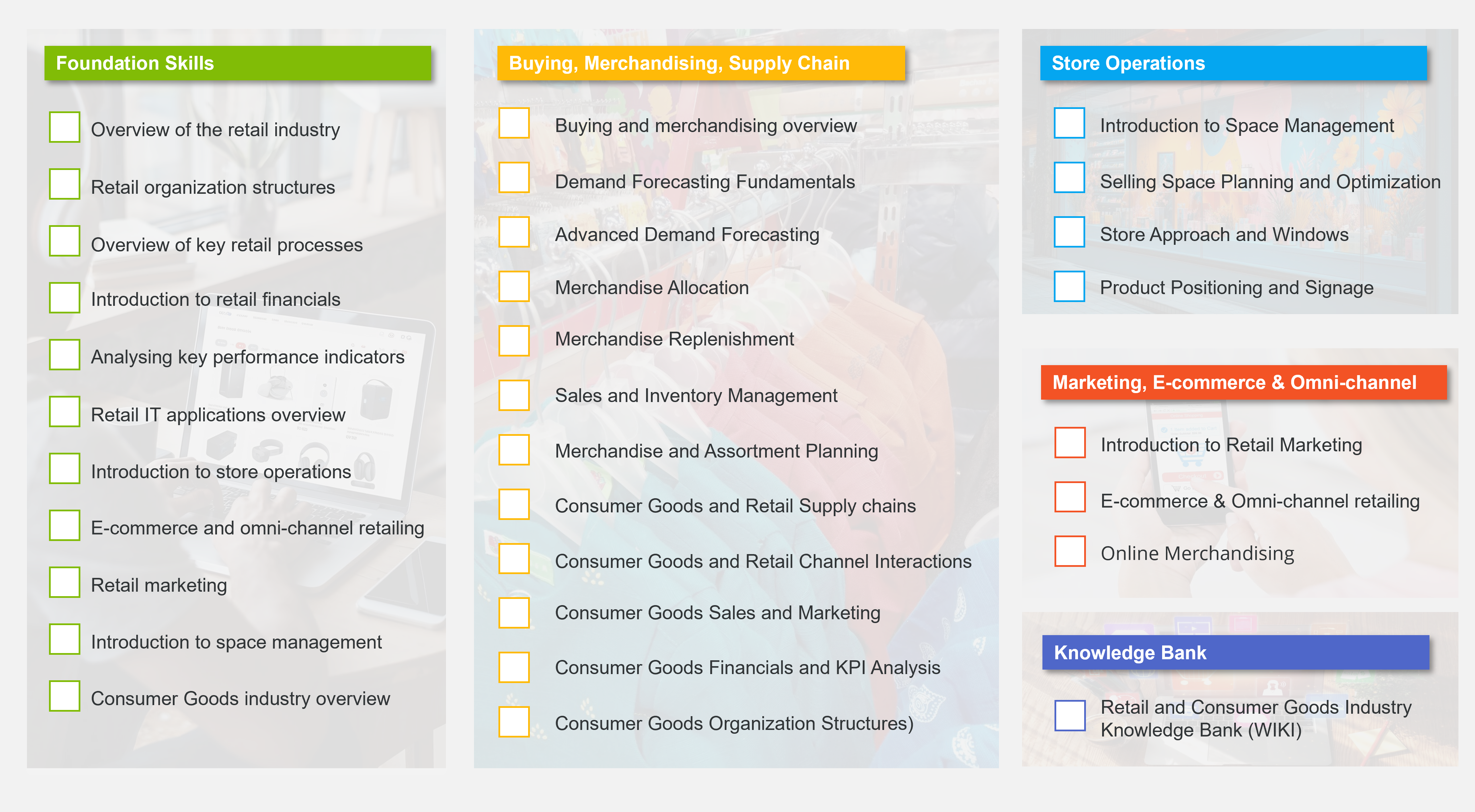
Apart from content, the knowledge bank contains a library of over 60 downloadable job aids, such as checklists, and tools to help learners in their day-to-day duties. The checklists includes things like a checklist for getting the store ready for business each day, what to cover in an end of season review in the buying office, and what the Real Estate department should check when evaluating a new potential store location.
NASBA
At the time of writing, 24 Martec classes are NASBA certified. NASBA is the National Accounting Standards Board of America, who licence all Certified Public Accountants (CPAs) to practice in the US. Martec have adopted their standards for our entire class portfolio because they are one of the most stringent standards organisations in the world. By October 2026, all Martec classes will be NASBA certified. Classes are audited by NASBA periodically.
NASBA issues CPE credits to CPAs that graduate our classes. Martec issues credits to any other organisation using its products adhering to the same standards.
Click here for more information.
Martec Products and Data Jumpstart
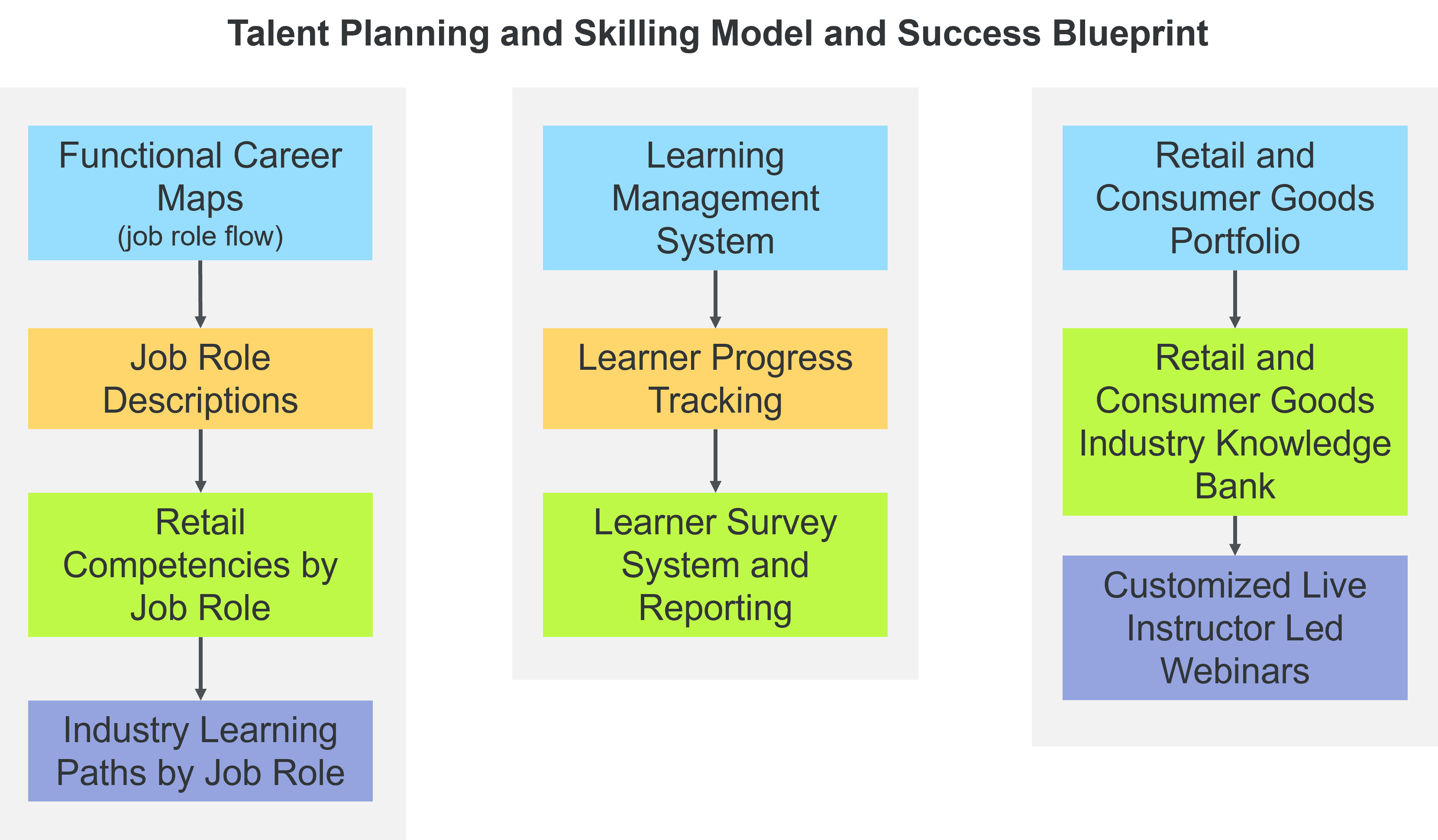
This chart summarises our positioning to help any customer in our target markets jump start any training or upskilling initiative.
Return on Investment Model
Martec has a Return on Investment model in spreadsheet format. The model has a multi-year profit and loss statement, a multi-year balance sheet extract (focused on fixed and current assets) and a multi-year free cash flow statement.
Our process starts with the company accounts in the model format for the year before the project starts. Then it adds in all extra expense costs and CAPEX expenditure estimates, followed by projections of how much sales and gross margins will increase by and other expense changes, depreciation and carrying cost of inventory changes, each year through the relevant number of years. The reports then show the change in pre-tax profitability, the changes in the fixed and current assets side of the balance sheet and the change in free cash flow. It also determines the internal rate of return.
Here’s a summary of the dashboard.
This model serves two purposes.
- When planning an upskilling project, it is used to estimate the quantified potential benefits and the return on investment, in a form that the company CAPEX committee or Chief Financial Officer will be familiar with and enable them to ask searching questions and potentially approve the investment.The format used will map into the company’s own financial planning processes. Different ways of proceeding after the initial pilot can be simulated to assess the best overall implementation plan in financial terms.
- The model serves is to track the achievement of the benefits as the upskilling or training initiative progresses through implementation, so that the company can see that everything is on track or take informed steps to remediate it.
Our model is built from the bottom up as shown in this table.
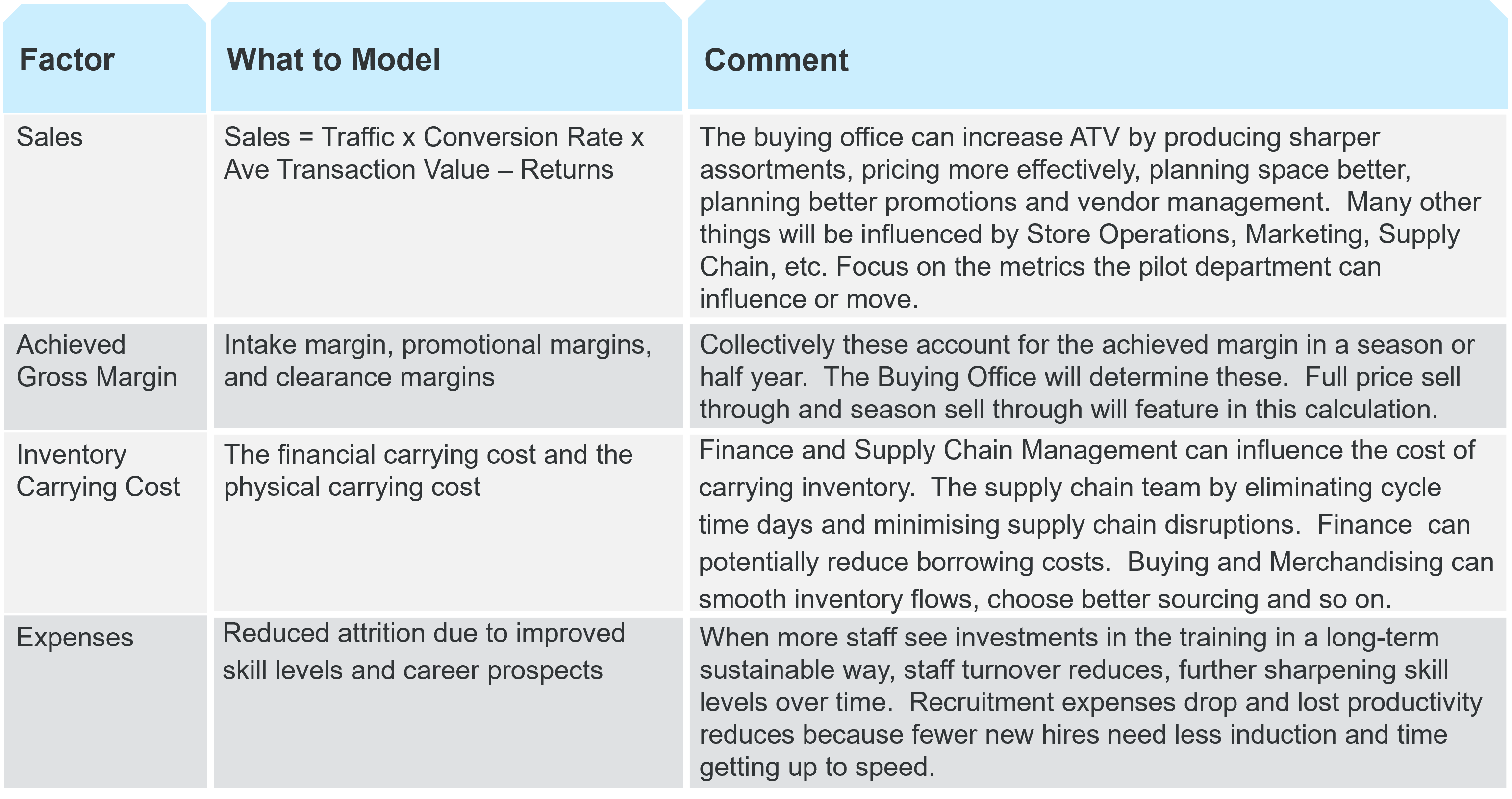
It is built this way to facilitate remediation, if necessary. Suppose, for example, that a predicted margin gain is not being achieved.
The gain was calculated assuming that the intake margin was maintained up to the full price sell through percent. There after the first permanent markdown and sometimes a second one was taken through to the end of the season. Throughout the season, a number of promotional markdowns would be used from time to time.
If remediation is necessary, the process is to confirm that the level of predicted intake margin was achieved, and full price sell through achieved the targeted percentage. Then was the season sell through percent achieved and was it at the predicted level of clearance markdown?
Finally, how much was invested in promotional markdowns and did these generate the predicted promotional lifts?
By investigating each of these factors, the source(s) of the shortfall can be identified. The training and implementation around the items that missed can be reviewed, tightened up and additional training provided where really needed.
We apply this approach through all aspects of the model.
We do not attempt to quantify the financial benefits from the soft skills training. But having built a number of ROI models for past clients over the years, we know that the maginitude of the benefits is sufficiently large, that it can support the targeted investments in soft skills in the learning paths.