


Upskilling And Reskilling A Department or Company
Upskilling and reskilling their workforce has become a key concern for many companies and CEOs. Skills are driving employee recruitment much more than qualifications. At the same time, AI is changing the skills that companies will need in future, the skill mix of their workforce, where existing jobs will disappear and new ones be created.
No-one knows how this will play out yet, or how long it will take for everything to become clear. These are the main questions to consider to shape the plan that will work best:
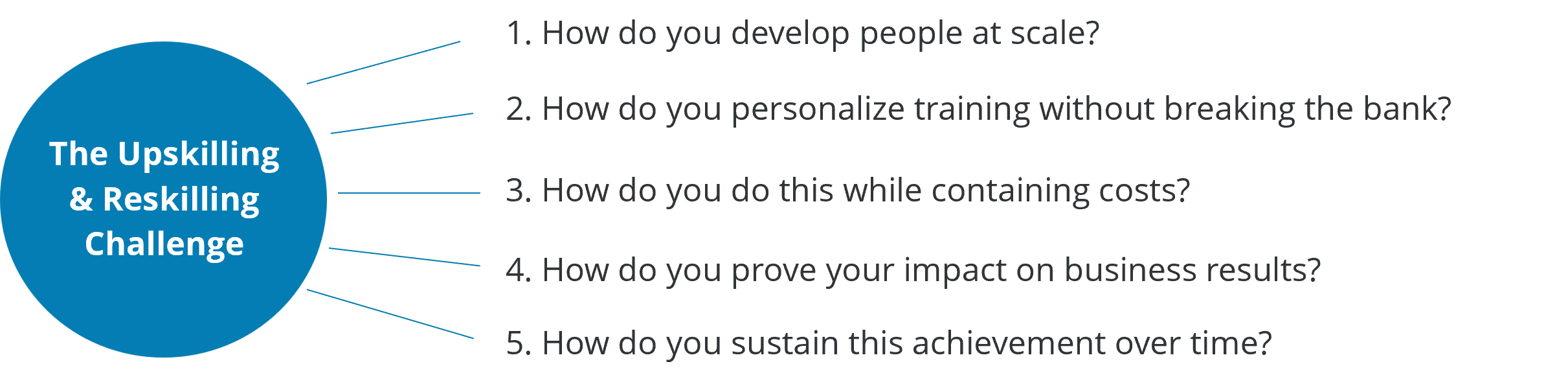
Apart from the disruptive effect of AI on individual business functions, the changes will have profound impacts for the Human Resources and Learning and Development (L&D) Departments. Talent recruitment, development, and management will become much more critical than at any time in the past. It will be years before the availability of AI skilled workers is enough to meet every company’s needs. Until then competition for other company’s skilled workers will be tough, and attrition could grow in companies that do not address this threat early enough.
Talent development will become something companies need to do, in varying degrees, for every employee that you wish to stay with the company.
Martec's approach to upskilling and reskilling is based on a year’s deep research into this whole area. We have documented a comprehensive approach to planning upskilling and reskilling for those that need it, progressing from entry level positions to top management, spreading the upskilling burden throughout individuals’ career paths, aiming to have a pool of people ready to fill the next level positions as vacancies are created. For square pegs in round holes - people that are worth keeping, sideways moves can be trained for, to help you hold on to people with potential value to the business, who may not be in the right spot just now.
Our approach will help L&D, in conjunction with Finance:
- Produce accurate costings for the necessary investment
- Produce a well-developed series of estimates of the benefits and show the estimated ROI in terms of expected profit increase, change in the balance sheet, improvements in free cash flow and the Internal Rate of Return.
For more information visit our Upskilling and Reskilling Toolkit page. Go here to learn more about our ROI model.
For individuals looking to maximize their career prospects, our career path maps will guide you to where you might wish to develop your career and the steps you might take to do it. Find the role that you are in now, or shortly to start, and study the learning path for that role. Our learning path pages are in the process of being revised, so please feel free to contact us to request the updated one you need. Currently these are available for Buying & Merchandising and Store Operations. We also have them for consultants, accountants and technology companies for the job roles that serve retail and consumer goods.
Career Maps and Learning Paths
Our upskilling process starts with career maps. Here’s an example for the Buying and Merchandising Department:
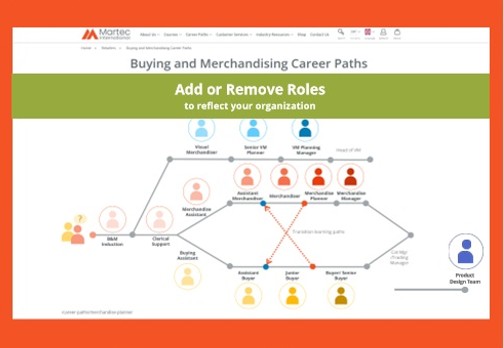
Career maps show the various roles in an organization and the progression from entry level to senior roles. They also show possible cross-over points for people looking for a change. Each role from entry level staff up to management positions has its own learning path. Job roles have job descriptions and statements of the skills for competencies needed by someone qualified to do that role.
Our career maps are generic industry maps. Individual companies may have a variety of differences. Larger corporations should use these as a starting point and tailor them to their specific situation.
You can see more examples of career maps for different company types and departments here.
These maps play an important role in planning a complete department upskilling project or a complete company upskilling project over a number of years. More about this later.
Learning Paths
Each icon shown on the career map relates to a specific job role in the organization and has its own unique learning path. Learning paths are recommended sequences of training and upskilling to equip learners to master the key industry skills in their role. They help individuals plan a development strategy for themselves or to help managers and executives plan development strategies for their departments or company.
Each learning path includes the following elements:
- A statement of the skills needed to be considered proficient in that role. This is based on typical job descriptions for the role plus adjustments for the way the industry is changing due to trends like AI transforming businesses and the level of supply chain disruptions.
- A list of training interventions to educate someone for that role. This can be content that they study in the role or before being promoted into it. These interventions include a mixture of classes, reading and downloadable resources including tools to use in the job role, where appropriate. Many include exercises to practice skills. Learning paths for more senior job roles may include live instructor web-based classes to further deepen skills
- In most cases, they include the key performance indicators that should improve as the learner progresses. KPIs in this context relate to metrics that change the company’s accounts, such as inventory turn and achieved gross margin. These are measured and tracked on the specific products that this learner can impact ad they feed into a detailed ROI analysis as implementation as the upskilling project progresses.
Martec’s standard templates focus on the business process skills that Martec trains in. However, they have a section for client companies to add the soft skills that are needed in the role, such as critical thinking ability or leadership skills. For some elements Martec includes recommendations for this section.
Each learning path assumes that the learner has mastered the earlier learning paths in the career map or gained those skills from previous employment or training. If not they will also need to study missing sections from earlier job roles.
Martec will be pleased help with these customization efforts if needed.
The learning paths can also help individuals transition from one career path to another.
Here’s an example learning path. In this learning path the training resources have hyperlinks to the classes in our class portfolio. Clicking in these links will take you to more detailed information on each class.
For more detail on how the whole upskilling process works there are three 20-minute videos reviewing the stages in the upskilling and reskilling process:
Video 1 - Provisioning the Resources
Video 2 - Developing the Plan
Video 3 - Executing the Plan.
There is also a 10-page summary of a much larger white paper you can download.
The larger white paper is a 45-page blueprint of the step by step detail to implement a successful upskilling implementation. Clients using Martec training can request a free copy.
There is also an upskilling and reskilling toolkit available for purchase in the Martec Shop and is described in more detail in the link.
Benefits of the Martec Approach
Martec’s approach to upskilling and reskilling has a number of unique benefits:
- Our investment in learning path definitions and related tools greatly simplifies the task for companies defining and maintaining their own skills taxonomies.
- Our product portfolio enables companies to jump start an implementation and save a lot of development and implementation cost.
- Our talent planning, development and monitoring process steadily reduces L&D costs as a percent of sales over time as the planning focus switches from “catching up” with a whole department to investing the most training budget in the places where it will do the most good. For example, today you might need to apply the same training to all store managers as part of “catching up”. In future years the bulk of the training investment for that group will be identifying how many new stores managers you will need in each year to address promotions up or across the organization, external attrition and news tore openings.
- Our unique ROI evaluation model measures your return on investment in financial terms all boards of directors understand, such as EBIT - earnings before interest and taxes.
- Our methodology includes a remediation process if the anticipated financial benefits are not being achieved.
- Some increase in training costs will be offset by lower external recruitment and onboarding costs and the other part by the hard benefits of greater free cash flow, higher EBIT and proportionately more productive assets such as inventory and selling space.
Why delay? Watch the first video above today and if that strikes a chord with you watch the rest of the series and/or read the 10-page management summary.
We are happy to answer questions on any aspect of this whenever they arise. Contact us and we will respond as soon as possible.
We are rated 86% to 87% across four measured questions, with a Net Promoter Score of 55, from learners in 58 countries
How the Retail and Consumer Goods Knowledge Bank Supports Upskilling
As an example, the table below shows how Martec defines the skills or competencies needed for a typical Assistant Merchandiser role. Individual companies can customize this template as necessary and add extra items where they have unique requirements. (We often assist in this).
The purpose of this table is to highlight how the knowledge bank plays an important role in initiatives to upskill or reskill staff members.
If you are an individual learner, each class is licensed for a limited period of study. The Knowledge Bank is included free of charge as an additional resource and is provided on a 12-month licence. If you do not license any classes, you may still access the Knowledge Bank independently on a renewable 12-month licence.
Corporate e-learning licensees also receive complimentary access to the Knowledge Bank for the duration of their company licence. Once your learning objectives have been met, you may continue to license the Knowledge Bank on its own, providing ongoing support, opportunities for revision, and access to updated and newly released job aids to help maintain your productivity gains.
You can also build internal applications or tools, which include links to educational material and other tools in the knowledge bank, to help maximize productivity potential.
To evaluate the usefulness of our Retail and Consumer Goods Industry Knowledge Bank in more detail, take advantage of our free trial. Just click here and enter free trial in the message box.
If you would like an overview of our approach to upskilling your teams, watch this 3-minute video.